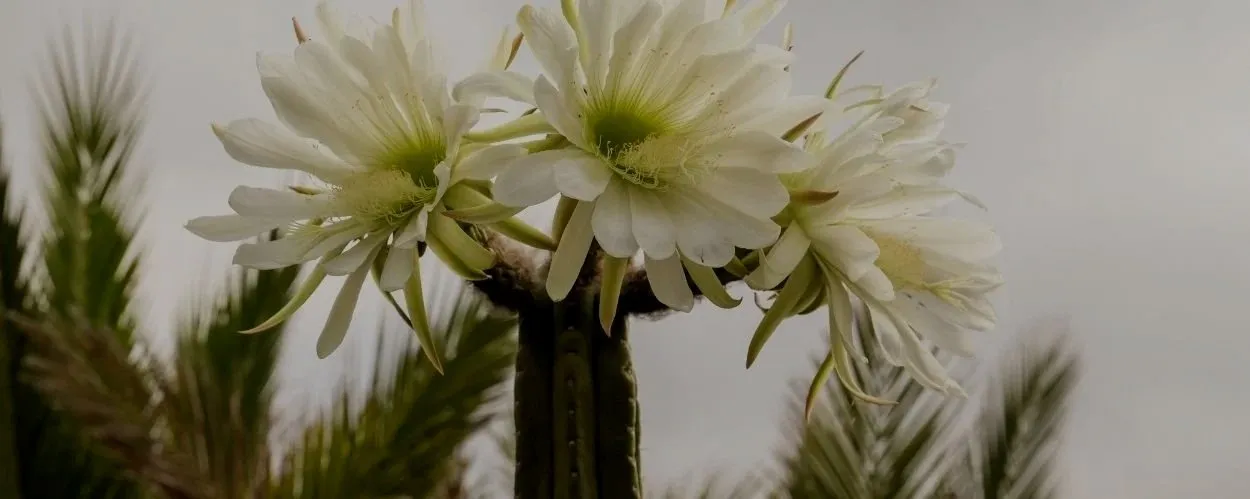

Wachuma is one of the names for the San Pedro cactus, a tall columnar cactus native to the Andes of Peru, Ecuador, Bolivia and northern Chile. It has a long history in Andean traditional medicine, and its active compound is mescaline. At Ruhani, wachuma is offered only inside The Arbol Method, with preparation before and integration after.
What does the word wachuma mean?
It is one name among several. The same cactus is called achuma, huachuma, aguacolla and San Pedro. San Pedro is Spanish for Saint Peter, and the name alludes to the gatekeeper of heaven.
How long has wachuma been used?
A long time. Archaeological work in northern Peru points to ritual use of the San Pedro cactus in cultures such as the Cupisnique, around 1500 BC, and the tradition continues in Andean shamanism today.
What is in wachuma?
Mescaline. Scientists broadly agree it is the active principle behind the cactus’s traditional use. Concentrations vary between plants, which is one reason this work belongs with experienced guides and a prepared body.
How is wachuma different from ayahuasca?
Ayahuasca is an Amazonian brew. Wachuma is an Andean cactus. From guiding both, Faisal sees ayahuasca tend toward intense and cathartic work and wachuma toward gentle, grounding work, and people vary. The full comparison is on the Ayahuasca vs wachuma page.
How does Ruhani work with wachuma?
The Reset Retreat includes 3 ceremonies with ayahuasca and wachuma, sequenced by your guide to your readiness. Holistic Sherpa Faisal Khattak trained in Peru with indigenous masters. Both medicines are offered only within The Arbol Method: 4 weeks of preparation, 7 days on site, and 4 weeks of integration.
If you want to prepare on your own first, the Wachuma Readiness Blueprint walks you through it.
Related reading
What we share reflects our personal journey and perspective. If something doesn't resonate with you, take what serves your heart and leave the rest with love. Our posts are intended for educational and inspirational purposes only. Sacred plant medicines are powerful tools that deserve deep respect and should only be used under the guidance of skilled, experienced practitioners in a safe, ceremonial setting. Always approach them with care, preparation, and proper support. Healing is a personal path. Walk it wisely.
Sources
- Ogunbodede et al., Journal of Ethnopharmacology 131 (2010) 356 to 362, on mescaline in Echinopsis (San Pedro) species and the native range, uvm.edu. Accessed 2026-10-29.
- Revista de Neurología 2006, 42(8): 489 to 498, Mescaline and the San Pedro cactus ritual: archaeological and ethnographic evidence in northern Peru. Accessed 2026-10-29.
- Wikipedia, Echinopsis pachanoi, for the list of common names. Accessed 2026-10-29.